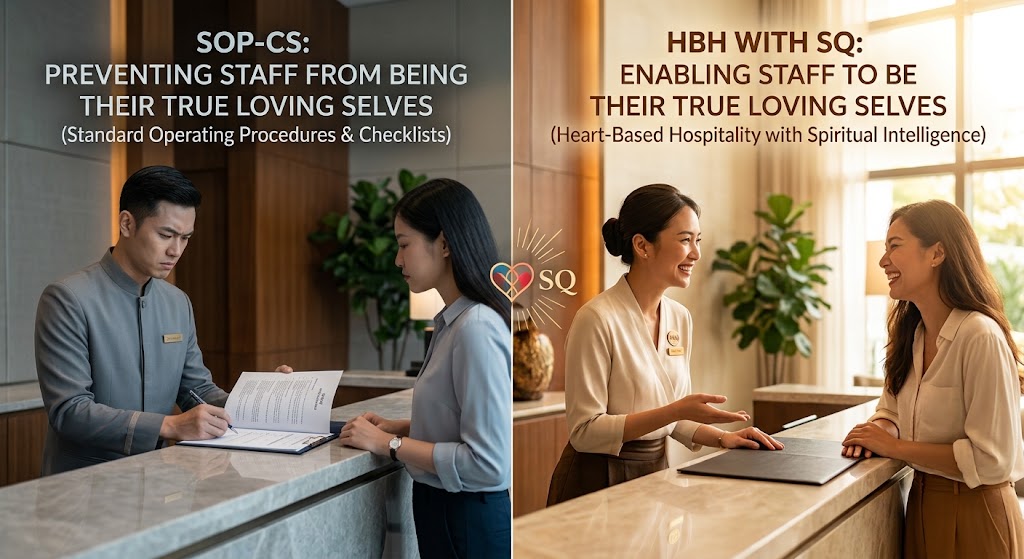
The industry has a well-worn story about staff development: you train someone, they acquire a skill, the skill shows up in their performance metrics. Smile at check-in. Anticipate the request before it’s spoken. Recover gracefully from a complaint. All of it measurable, all of it teachable in the way a checklist is teachable.
What it has no language for is what actually happens when a staff member spends real time in heart-based practice — not performing warmth, but cultivating the inner state warmth comes from.
I have watched it happen, workshop after workshop, in hotels across Thailand. It doesn’t look like skill acquisition. It looks like softening. Staff who arrived guarded visibly relax over the course of a few sessions. They smile more easily, and the smiles stop looking uniform. Something more unsettling to conventional training logic also happens: they become more their natural selves. Not more “on-brand.” More particular — their own humour, their own warmth, their own way of noticing a guest, and presence, start to show through the role rather than being smoothed out by it.
Observing them in the operation afterwards as the constricting cloak of SOP-Customer Satisfaction is removed is beautiful!
The industry’s challenge
This should be a business problem worth solving, and instead it’s invisible to the systems meant to track staff development. Engagement surveys ask about satisfaction and burnout risk, not about interior state. Training ROI is measured in service scores and repeat-guest rates, not in whether a housekeeper looks more like her true self at the end of her shift than at the start. HR departments have entire frameworks for skill competency and almost none for what we might call spiritual capacity as seen in the depth of presence a person can sustain under the pressure of service work.
The result is that hotels are, without knowing it, already producing this transformation in isolated pockets — through a good manager here, a workshop there — and then losing it, because nothing in the system recognizes it as valuable, names it, or protects the conditions that produced it.
The mechanism — and the evidence
What’s happening isn’t behavioural. It’s not that staff learn a gentler technique. It’s a measurable physiological shift, and it has a name: heart coherence, the state of increased heart-brain synchrony that HeartMath Institute has spent three decades researching. It grows as the employees are immersed in capacity development activities. The hotel industry has no idea what it is missing out on.
In our workshops, I use their Quick Coherence techniques directly, and ask staff to practice them in their own morning briefings before they start their shift. What I see anecdotally — the softening, the easier smile, the greater self-relaxation over weeks — tracks closely with what the research documents. HeartMath’s data shows that consistent practice measurably shifts the body’s stress chemistry: cortisol down, the DHEA vitality hormone up, a ratio change researchers interpret as a repatterning at a fundamental physiological level. Alongside that, practitioners show consistent reductions in anxiety, depression, anger, hostility and burnout, and increases in resiliency and emotional vitality. A controlled study of a HeartMath workshop found the same pattern under scientific scrutiny — significant pre-to-post gains in coherence, mood and resilience, outperforming a matched control group.
Guardedness, in other words, isn’t just an emotional posture. It’s metabolically expensive. It takes a physiological toll to perform warmth you don’t feel, shift after shift. When staff are given real practice in dropping that performance — in actually feeling toward a guest rather than simulating feeling — the release isn’t just psychological. The body itself shifts state. The face changes because the physiology changes.
And because that state is closer to who a person already is beneath the professional mask, coherence doesn’t produce uniformity. It produces the opposite: individuality becomes visible again. This is the part hospitality’s SOP culture is least equipped to expect, because SOP culture assumes consistency requires standardization. Heart-based practice suggests the reverse — that the most consistent thing a hotel can offer is not a script everyone performs identically, but a physiological state everyone is supported in returning to each morning, which then expresses itself differently through each person.
The daily practice, not the one-off workshop
None of this holds if it’s treated as a single event — a workshop staff attend once, then return to old habits. What actually produces the lasting shift is a daily deepening: heart-touching stories, music, spiritual quotations, brief meditations, and breathing exercises, worked into the rhythm of the working day itself rather than confined to a training room. This accompanied by the activities in The 11 Elements, which ensure that the new culture takes root deeply and grows continuously.
This is where the business case sharpens considerably. The visible effect on staff — softer, warmer, more genuinely present — is only half of it. The other half shows up in a number every hotel already tracks and worries about: turnover. Staff who go through this daily practice don’t just perform better; they stay. Not because retention was the goal, but because a workplace that helps a person feel more coherent, more at ease in themselves, more genuinely happy, is a workplace people are reluctant to leave – especially if moving to another hotel means wearing again the constricting cloak of the SOP-Customer Satisfaction culture.
The industry spends enormous sums fighting turnover through pay, scheduling flexibility, and perks. Almost none of it addresses the more basic fact that people leave jobs that leave them depleted, and stay in ones that leave them more whole than when they arrived.
What it feels like from the inside
Ask a staff member partway through this change process what’s changing, and they rarely describe it in terms of skill. They describe it as something closer to coming home to themselves.
The shift away from a guarded, ego-driven posture toward a heart-based one isn’t a move into fragility — if anything, people report the opposite. The softening is backed by a kind of resilience that a defensive posture never had. Love stops being a mood that depends on the guest, the shift, or the day going well, and becomes something closer to a baseline they return to rather than a peak they occasionally reach.
Patience in a difficult conversation, compassion instead of criticism, staying present instead of shutting down — these stop requiring effort and start becoming the default response. And the quiet “us versus them” that service work can breed toward guests — the silent sorting into easy and difficult, deserving and demanding — begins to dissolve into something closer to genuine curiosity about the person in front of them and a desire to infuse the interaction with the spiritual essence of hospitality – unconditional love, compassion, loving-kindness, and heartwarming care.
Internally, people describe a quieting of the noise they didn’t realize they’d been carrying — the overthinking, the low-grade anxiety, the reactivity that used to fire before they’d even decided to let it. In its place: a spaciousness, a sense of no longer fighting against the day. Choices get clearer. Effort decreases. And the emotional register that used to show up only occasionally — joy, gratitude, a settled serenity — starts becoming where they live most of the time, rather than where they visit.
What changes in how they meet the world follows from this. Stress stops triggering the old fight-or-flight scramble; there’s a pause now, a moment where they access something steadier before responding. They become more attuned to what others are feeling, in part because they’ve learned to stay with their own difficult emotions instead of fleeing them — which means they can actually hold space for a guest’s distress instead of rushing past it. And underneath all of it, something in their motivation quietly repoints: away from self-preservation and personal grievance, toward a genuine, unforced wish to help and to connect.
None of this shows up on a training scorecard. But it’s the difference between a staff member who has learned to perform hospitality and one who has simply become, more and more, a person true hospitality flows out of naturally.
The capacities themselves — what develops in the person
The softening isn’t one undifferentiated change. Each spiritual capacity, as it develops, shows up as a distinct shift in how a staff member holds themselves and meets a guest. In total, 18 capacities are developed over time. Here are 8 of the capacities:
Radiance shows up first, often before anything is said. A staff member who has cultivated radiance carries a warmth that guests register on entry — not a performed smile timed to a greeting script, but something closer to an ambient quality of presence. Guests can’t always name why one employee’s welcome feels different from another’s; radiance is usually the answer.
Presence changes what a guest experiences as being seen. A staff member developing presence stops processing the guest as the next item in a queue of tasks and starts meeting them as a specific human being, in this specific moment. The guest feels the difference between being handled and being noticed, even in an exchange that lasts ten seconds.
Serenity is what makes service recovery survivable — for the staff member, not just the guest. As serenity develops, complaints stop landing as threats to be defended against and start being absorbed without disturbing the person’s center. This is the capacity most directly responsible for staff no longer looking depleted at the end of a difficult shift.
Compassion moves a staff member past the recovery script and into actual contact with what a guest is feeling underneath the complaint — the exhaustion of a delayed flight, the anxiety of a first anniversary trip going wrong. Where serenity keeps the staff member steady, compassion is what the guest experiences as being cared for rather than processed.
Open-Minded Hospitality dissolves the quiet judgments service staff often carry about guests — about class, behavior, appearance, demandingness. As this capacity develops, staff extend the same unguarded welcome to every guest, and the guest can feel the absence of being silently assessed.
Inner-Directedness is what allows a staff member to act on what a moment actually calls for rather than defaulting to “the manual doesn’t cover this.” It restores a kind of moral confidence — staff begin trusting their own wisdom enough to depart from procedure when procedure and genuine care point in different directions.
Unconditional Care / Love is the capacity that turns ordinary operational tasks — folding a towel, resetting a room — into acts carrying gentleness in themselves. Guests describe hotels where this is present as feeling cared for in a way they can’t quite locate in any single interaction; it’s diffused through the whole environment.
Intuition develops last in most people, because it depends on the others. Once staff are radiant, present, serene, compassionate, unjudging, inner-directed, and genuinely loving, intuition becomes the natural byproduct: staff start anticipating what a guest needs before it’s spoken, not through training in anticipation techniques but because they are finally attentive enough to notice.
Closing
The guest, of course, feels all of this. A softened, more-themselves staff member is not a marginal improvement on a well-trained one. It’s a different category of encounter — the difference between being served and being met. What the industry currently treats as an unmeasured, unremarkable side effect of a good workshop is, in fact, the entire point: not better-performed hospitality, but a more coherent, more radiant, more genuinely present human being showing up for work. The hotel industry has no idea of what it is missing; of what is possible; and of the revolution in hospitality that is waiting to happen.