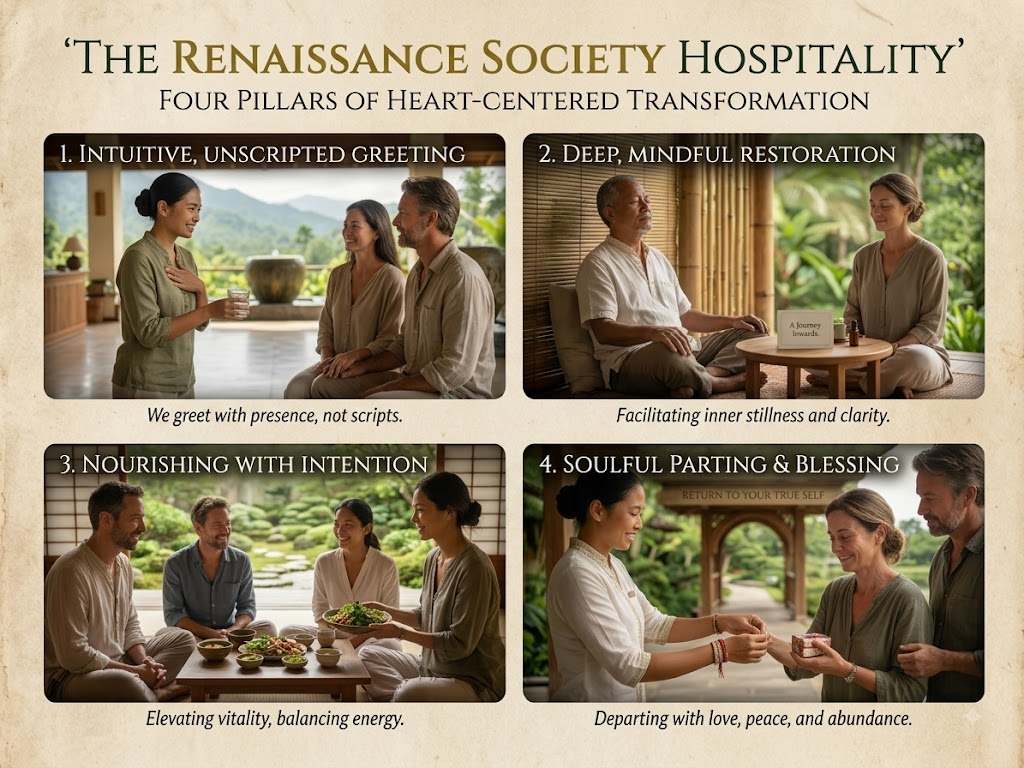
Here is a comprehensive article exploring the integration of Heart-based Hospitality, Spiritual Intelligence, and the societal models of Rolf Jensen.
In the landscape of modern hospitality, a profound tectonic shift is underway. For decades, the industry has been dominated by the Information Society (the Fourth Society), where success was measured by technical proficiency, efficient Standard Operating Procedures (SOPs), data management, and the reliable delivery of physical amenities. A luxury hotel was defined by the quality of its linens, the speed of its Wi-Fi, and the frictionless nature of its transactions. To a large extent the global hotel industry is still dominated by the Fourth Society model.
However, we are now living in the tumultuous overlap of the next two waves of human progression: the Fifth Society (The Dream Society) and the emerging Sixth Society (The Renaissance Society). To navigate this new terrain, a new form of leadership and operational philosophy is required. Forward-thinking hoteliers are discovering that the ultimate competitive advantage lies in integrating Heart-based Hospitality with Spiritual Intelligence.
This integration moves hospitality beyond the purely material, emotional, or transactional, to transforming the hotel from a “home away from home” into a sanctuary of elevation—a dedicated space for personal restoration and inner transformation.
Understanding the Societal Shifts: From Stories to Meaning
To fully grasp the relevance of Heart-based Hospitality and Spiritual Intelligence, we must first understand the journey humanity is taking, as outlined by futurists like Rolf Jensen.
The Fifth Society: The Dream Society
As basic needs became easily met in affluent economies, the primary commercial metric shifted from convenience and efficiency (the Fourth Society) to emotion and storytelling. This is the Dream Society. In this model, success is achieved by selling an immersive narrative, a unique aesthetic, or a memorable lifestyle experience.
A Dream Society hotel isn’t just a place to sleep; it is a “story teller.” It uses design, branding, local art, and curated “moments” to connect emotionally with the guest. The goal is to provide a rich emotional experience that allows guests to feel something unique. However, as these themed experiences became universal, they began to feel transactional. Guests have begun to see through scripted “lifestyle service” and crave something deeper.